
How to Measure Bathroom Faucet Size

When it comes to setting up or renovating your bathroom, the importance of accurate measurements becomes evident very quickly—sometimes even down to the smallest millimeter. Over the years, I’ve encountered numerous instances where incorrect measurements led to faucet installations that simply didn’t work out, resulting in unnecessary complications and delays.
That’s why, in this comprehensive guide, I’ll walk you through each crucial step involved in measuring your bathroom faucet properly. With these methods, you’ll ensure that the faucet you choose not only fits your setup perfectly but also avoids the common pitfalls of a poor installation.
Why Measuring Bathroom Faucets Correctly is Important
A properly fitting bathroom faucet does much more than just serve its functional purpose—it also contributes to a clean, polished appearance and ensures a hassle-free installation process. Installing a faucet without paying attention to accurate measurements or proper fittings can quickly lead to a host of frustrating issues.
These may include water splashing out of place, uneven or unstable placement, and the potential requirement for additional tools or hardware just to make things work. Such avoidable complications can make the installation far more difficult and time-consuming than necessary.
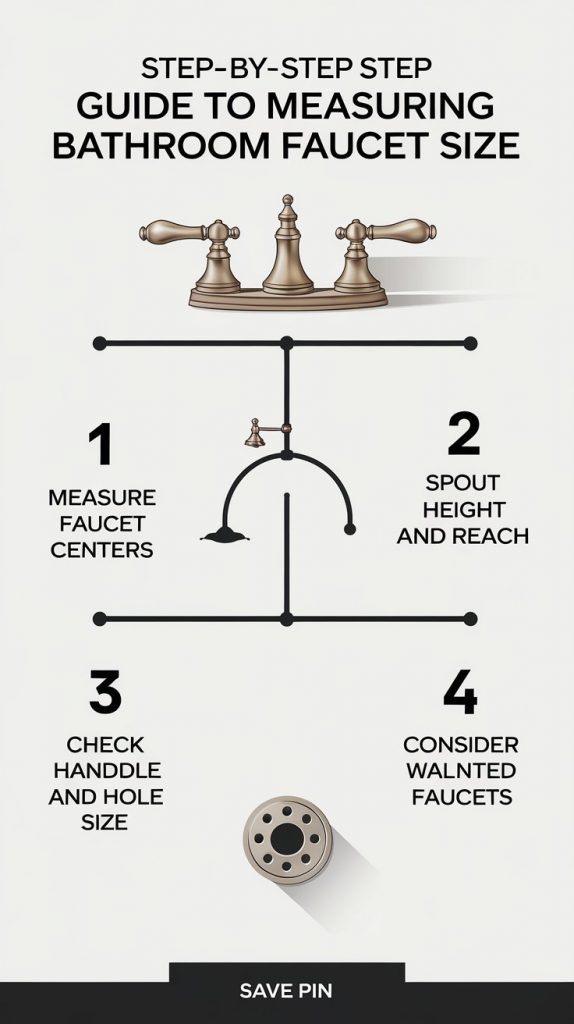
Step-by-Step Guide to Measuring Bathroom Faucet Size
Measure Faucet Centers
One of the most essential and primary measurements you need to take when selecting a bathroom faucet is the faucet center. This refers to the distance between the centers of the two outermost holes where the faucet will be mounted on your sink or countertop. Getting this measurement right is crucial, as it determines the compatibility of your faucet with the existing hole configuration.
The most commonly found faucet center measurements fall into standard categories, making it easier to match with widely available faucet models.
Centerset: This type of faucet setup is designed with a standard 4-inch spacing between the mounting holes. It’s a compact configuration commonly used for smaller sinks or tight bathroom spaces where saving surface area is a priority.
Widespread: In contrast, widespread faucets have a more flexible and customizable spacing that typically ranges between 8 and 16 inches from one hole to the other. Because of this variability, it’s especially important to take precise measurements to ensure a proper fit, particularly when dealing with larger sinks or countertops that offer more space.
| Faucet Configuration | Hole Spacing | Ideal Sink Type |
|---|---|---|
| Centerset | 4 inches | Small Sinks |
| Widespread | 8–16 inches | Larger Sinks |
| Single-Hole | No measurement | All Sink Types |
Measure Spout Height and Reach
To begin, start by measuring the spout height, which refers to the vertical length from the bottom base of the faucet all the way up to the highest point of the spout. This measurement is important because it influences both the faucet’s appearance and how much clearance you’ll have for washing hands or filling containers.
Next, measure the spout reach—this is the horizontal distance from the center of the faucet’s base to the center of your sink’s drain. Getting this measurement right is crucial, as it helps ensure that water flows directly into the sink basin, minimizing any risk of splashing onto the countertop and keeping your bathroom cleaner and more functional.
| Measurement Type | Definition | Typical Range |
|---|---|---|
| Spout Height | Distance from base to the highest point of spout | 3–10 inches |
| Spout Reach | Horizontal distance from faucet to sink center | 4–8 inches |
Check Handle Spacing and Hole Size
When dealing with a faucet that has separate handles, such as in a widespread configuration, it’s important to measure the spacing between those handles accurately. These handles are not connected to the spout and are typically installed individually, with a spacing range that usually falls between 8 to 16 inches.
Measuring this distance ensures that the handles will align properly with the existing holes in your sink or countertop. Additionally, you should be aware of the borehole diameter—the size of the holes through which the faucet components are installed.
Another detail to consider is the spindle movement, which refers to how far the internal spindle mechanism rotates to control water flow. These spindles typically operate within a range of 1 to 1.5 inches apart, and understanding this can help ensure a smooth and responsive faucet operation.
Consider Wall-Mounted Faucets
If you are working with a wall-mounted faucet, the measurements will vary slightly compared to traditional sink-mounted faucets. In this case, it’s essential to measure the reach of the faucet carefully. This is the distance from the wall, where the faucet is mounted, to the center point of the sink drain. Getting this measurement right ensures that water flows directly into the sink without splashing.
Additionally, wall-mounted faucets should generally be installed at a height of about 3 to 6 inches above the top edge of the sink. This installation height provides a comfortable space for everyday use and helps prevent water from splashing outside the sink area.
Common Faucet Types and Measurements
| Faucet Type | Typical Measurements | Notes |
|---|---|---|
| Centerset | 4 inches center-to-center | Compact for small sinks |
| Widespread | 8–16 inches center-to-center | Separate handles and spout for larger sinks |
| Single-Hole | No spacing required | Only spout and handle combined into one unit |
| Wall-Mounted | Measure reach from wall to sink | Requires precise measurement for optimal reach |
Conclusion
Taking accurate measurements ensures a smooth installation process and optimal performance from your bathroom faucet. It minimizes the chances of fitment issues and helps you avoid the inconvenience of returning or modifying hardware later on.
Whether you’re installing a basic centerset faucet or working with a more advanced wall-mounted model, following these step-by-step measurement guidelines will help you make confident, informed decisions. Always double-check your measurements before purchasing, and if you’re unsure about any part of the process, don’t hesitate to seek advice from a plumbing professional.
FAQs
How much space is typically required for a bathroom faucet?
Most bathroom faucets use a 4-inch spacing for centerset models and between 8 to 16 inches for widespread setups.
How can I measure the spout reach of a faucet?
To determine the spout reach, measure the distance from the center of the faucet base to the center of your sink’s drain.
Is it possible to install a single-hole faucet on a sink with three holes?
Yes, you can use a deck plate to cover the extra holes when installing a single-hole faucet on a three-hole sink.
What’s the method for measuring a wall-mounted faucet?
Measure the horizontal distance from the wall where the faucet is mounted to the center of the sink to ensure the reach is appropriate.
Do all bathroom faucets fit every sink?
No, bathroom faucets come in different configurations. It’s important to measure both the sink and the faucet setup to confirm compatibility before installation.


